
SIMply the Best: UAB Clinical Simulation recognizes Sharon Phelan, Denise Graham with second annual Sim First Award
UAB Clinical Simulation has named Sharon Phelan, M.D., and Denise Graham, OTR/L, recipients of its second annual Sim First Award, recognizing their commitment to expanding simulation-based education and preparing healthcare professionals to respond confidently to critical situations.
Established in 2025, the Sim First Award celebrates “friends of simulation” who create transformative learning experiences, demonstrate excellence in facilitation and collaboration and foster safe, inclusive learning environments. Recipients are nominated by members of the Clinical Simulation team and selected annually near the conclusion of the fiscal year.
This year’s recipients exemplify that mission through their work with two distinct groups of learners: healthcare professionals caring for obstetric patients in rural communities across Alabama and rehabilitation clinicians preparing to respond to medical emergencies.
Sharon Phelan: Bringing OB Education Beyond Labor and Delivery
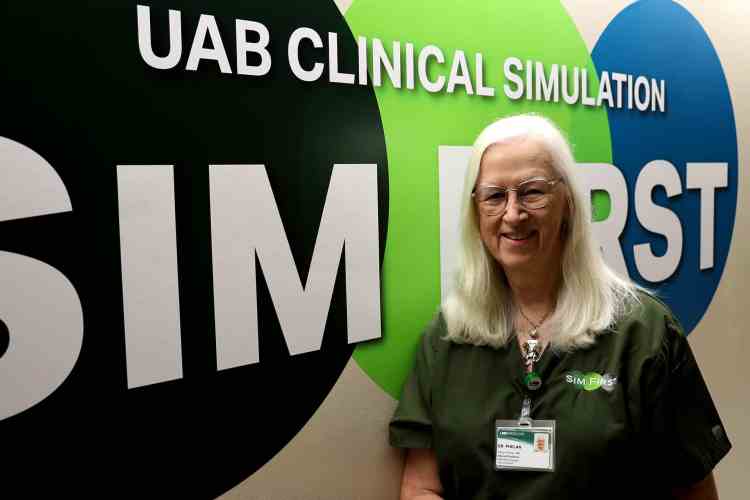
After a 50-year career in obstetrics and gynecology, Sharon Phelan, M.D., continues to share her expertise with healthcare professionals who may have limited experience managing obstetric emergencies.
A retired OB/GYN and longtime simulation advocate, Phelan frequently accompanies UAB Clinical Simulation’s Mobile Simulation team to Alabama Rural Health Collaborative partner institutions across Alabama, facilitating scenarios that help emergency department staff and other non-obstetric providers recognize, stabilize and manage complications involving pregnant and postpartum patients.
For Phelan, receiving the Sim First Award reinforces the importance of making this education more widely available.
“I am flattered,” she said. “It supports my feeling that one of the ways to decrease maternal morbidity and mortality is to provide education and sims to the non-OB medical community.”
Phelan believes this training has become increasingly important as medical education evolves and opportunities for hands-on OB experience become more limited.
At the same time, she noted, pregnant and postpartum patients are presenting with increasingly complex medical conditions, requiring providers outside traditional obstetric settings to recognize and respond to potentially life-threatening complications.
Drawing on decades of clinical experience, Phelan emphasizes practical diagnostic and management techniques that can be performed with limited resources, particularly in facilities without dedicated labor and delivery services.
“As more rural hospitals and inner city hospitals are closing their OB units or closing altogether, we need to provide the education and resources to allow the remaining providers to be able to identify and stabilize/triage these patients until transport can be arranged,” she said.
Her simulations address emergencies, such as precipitous delivery, shoulder dystocia and postpartum hemorrhage, allowing participants to practice essential skills while identifying protocols and resources that can guide their response.
For Phelan, some of the most rewarding moments occur when learners overcome their apprehension about treating obstetric patients.
“It is rewarding to see the trainee transition from being scared of a pregnant patient to feeling more able to identify and stabilize these patients,” she said.
She also believes that humor and encouragement play important roles in creating memorable learning experiences.
“If you are having fun or a positive experience, you are more likely to remember the information and skills learned during the activity,” she said.
Denise Graham: Empowering Rehabilitation Professionals through Simulation
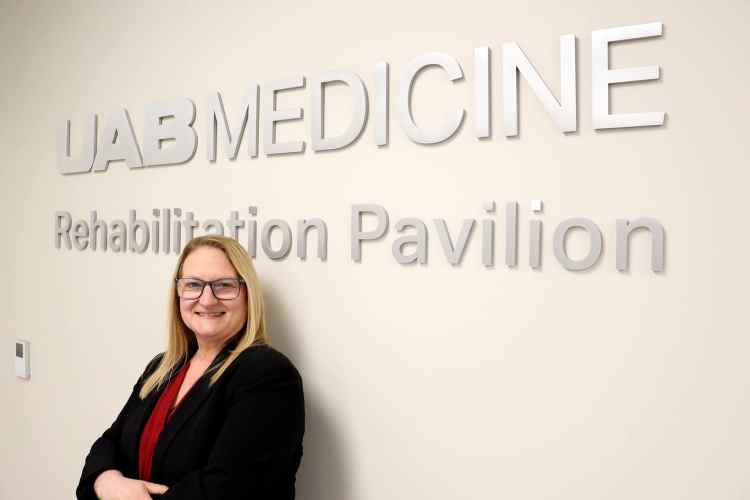
For Denise Graham, OTR/L, rehabilitation services education coordinator with UAB Medicine’s Spain Rehabilitation Center, simulation has become an essential tool for preparing rehabilitation professionals to respond to medical emergencies.
A passionate advocate for experiential learning, Graham has helped expand simulation opportunities across rehabilitation disciplines, particularly through rapid-cycle deliberate practice (RCDP) and code response training.
“Receiving the Sim First Award is both an honor and a little surreal,” Graham said. “When I first became involved with simulation-based education, I wasn’t thinking about awards or recognition. I simply saw an opportunity to provide rehabilitation professionals with experiences that would help them feel more prepared when faced with challenging clinical situations.”
Graham recognized that rehabilitation clinicians, who frequently work closely with patients during mobility exercises and other activities, may be among the first to recognize a change in a patient’s condition.
Yet opportunities to practice emergency response skills have not always been readily available to these professionals. “I’ve always felt that our therapists deserve the same opportunity to develop and practice these critical skills as other members of the healthcare team,” she said.
Through RCDP, Graham helps clinicians practice responding to emergencies in a supportive environment where they can receive immediate feedback, refine their skills and repeat scenarios until they feel more confident.
These exercises strengthen not only technical skills, but also communication, teamwork and situational awareness, helping rehabilitation professionals recognize their roles within the larger emergency response team, she said.
For Graham, the impact is often most apparent in learners’ reflections after a simulation.
She recalled a therapist who had previously felt anxious about participating in a code event, particularly when navigating a crash cart and using emergency equipment. After practicing the scenario and receiving feedback, the therapist expressed a newfound sense of readiness.
“This was great! I feel so much better and much more prepared to help out,” the learner told her.
Those moments, Graham said, demonstrate why simulation is such a valuable educational tool.
“We can’t eliminate the stress that comes with real-life emergencies, but we can help people feel more prepared,” she said.
Graham also emphasized that her recognition reflects the collective efforts of the rehabilitation clinicians and simulation professionals who have helped bring these learning opportunities to life.
“This award is meaningful because it represents a shared commitment to improving care for our patients,” she said.
Celebrating a Shared Commitment to Learning
Although their specialties and learners differ, Phelan and Graham share a commitment to making simulation-based education more accessible, practical and meaningful.
“Their contributions embody the spirit of the Sim First Award and UAB Clinical Simulation’s mission to help individuals and teams practice before they deliver care,” said Marjorie Lee White, M.D., vice president of UAB Clinical Simulation.
UAB Medicine’s Clinical Simulation program offers opportunities for individuals and teams across UAB Medicine and beyond to practice before they deliver care. We encourage all who provide and support patient care to “Sim First.” Together, we can put our patients’ safety first.

0 Comments