
Clinical Simulation, PACCM collaboration gains momentum in second year
A UAB Medicine collaboration focused on mechanical ventilation is catching a second wind.
One year after UAB Clinical Simulation helped faculty from the Division of Pulmonary, Allergy and Critical Care Medicine (PACCM) launch a new mechanical ventilation curriculum, the program is beginning to realize some of the goals established during its inaugural offering.
Now in its second year, the simulation-based mechanical ventilation curriculum has expanded its audience and course content while reaching a goal established during its inaugural offering: enabling UAB faculty to independently deliver the three-day experience.
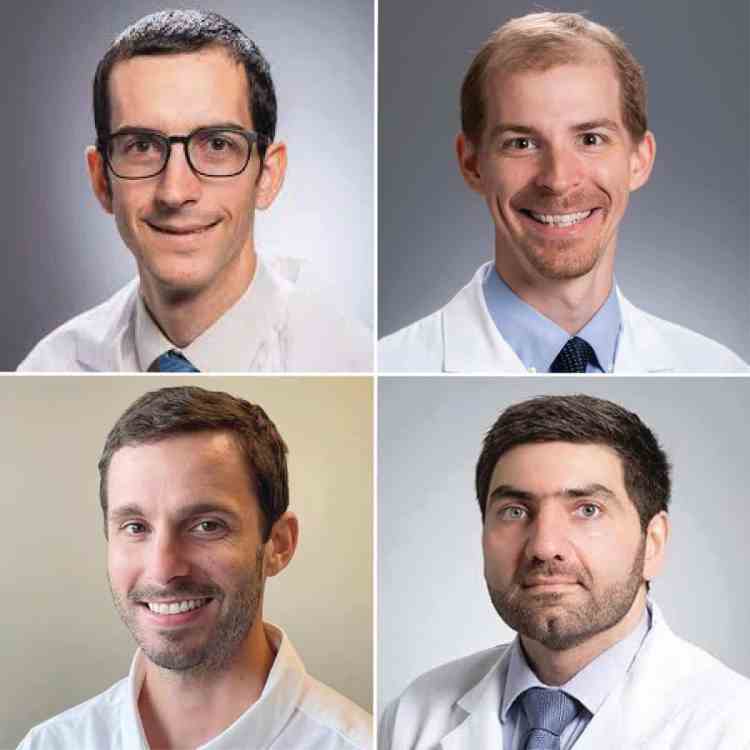
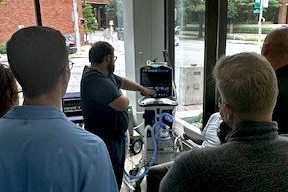
Held July 29-31 at the O’Neal Comprehensive Cancer Center at UAB Hospital and facilitated by PACCM faculty Drs. Steven Fox, Jonathan Kalehoff, Daniel Scullin and Abdulhakim Tlimat, the course once again utilized Clinical Simulation’s ASL 5000 lung simulators to provide hands-on training in mechanical ventilation. Unlike the inaugural offering, which included support from guest faculty experienced in delivering the curriculum at other institutions, this year’s course was led entirely by UAB faculty.
“We ran the simulations entirely on our own, using the ASL 5000s from UAB Clinical Simulation,” Kalehoff said. “We are becoming more facile with the simulation equipment and are in the midst of developing new simulations to use throughout the upcoming academic year, with plans to make additions and modifications to the simulation experience for next year’s three-day intensive course.”
Scullin said that independence marked an important step forward for the course’s facilitators.
“I think the facilitators were excited to deliver the three-day course completely independently,” Scullin said. “The more we teach the material, the better we understand it, and the more we get challenged with new questions related to the material.”
The course’s reach within UAB has grown, as well. In addition to fellows, attending physicians and respiratory therapists, this year’s audience expanded to include advanced practice providers, Scullin noted.
According to Kalehoff, that expanded participation grew in part from interest generated by the inaugural course.
“Our Pulmonary/Critical Care fellows have been implementing skills and strategies learned during the course in actual patient care,” Kalehoff said. “We see that the fellows are a lot more confident in managing ventilators for our patients.”
Scullin has observed similar development over the past year, particularly among second-year fellows who returned to the course after participating as first-year fellows.
“Overall, I have seen more engagement from all of our caregivers in understanding mechanical ventilation,” he said. “I think our trainees are really excited to learn about this topic and apply this knowledge at the bedside.”
For returning fellows, that progress was especially apparent.
“It’s really fun to watch the amount of growth that happens from day one of the course to day 365,” Scullin said. “The second-year fellows who retook the course this year were way farther along than they were as first-year fellows.”
Participant evaluations also reflected strong support for the experience. Of 28 attendees, 26 responded to the course evaluation, with every respondent strongly agreeing that the course should continue to be offered.
All respondents also agreed or strongly agreed that they learned new material, that the course would improve their practice and that its content was relevant. Participants similarly rated the course positively for its organization, value, instructor knowledge and learning format. Further, second-year fellows unanimously supported continuing to offer the course to fellows at their level.
Course leaders are planning follow-up activities and clinical applications throughout the academic year to reinforce the material between annual intensive courses.
Those activities will also provide opportunities for faculty to continue developing their use of the ASL 5000. Kalehoff said the team is currently creating new simulations, with plans to incorporate additions and modifications into next summer’s course.
And next summer could mark the program’s most significant expansion yet.
Following the inaugural course, Kalehoff described a vision of establishing UAB as a regional hub for the curriculum. With the first independently delivered course now complete, faculty are planning to invite regional pulmonary and critical care fellowship programs and community partners to participate in summer 2027.
“The vision continues as planned,” Kalehoff said. “The faculty who taught the course have been meeting to work to plan logistics for Summer 2027, in which we plan to invite regional fellowship programs and community partners to join us for the course.”
Scullin said the team is reaching out to programs across Alabama, Louisiana, Mississippi, Georgia and Tennessee to gauge interest. Capacity will limit how many programs can participate initially, but Kalehoff said sufficient outside interest could eventually lead the team to offer the course twice each summer.
Expansion is also expected to continue within UAB, with plans to train more respiratory therapists, advanced practice providers, faculty and fellows, Kalehoff added.
“I think we are all very excited to potentially broaden our audience even more,” Scullin said.
Interested in bringing simulation to your department or program? Email UAB Clinical Simulation at simulation@uabmc.edu to learn how you can get involved.
UAB Medicine’s Clinical Simulation program offers opportunities for individuals and teams across UAB Medicine and beyond to practice before they deliver care. We encourage all who provide and support patient care to “Sim First.” Together, we can put our patients’ safety first.

0 Comments