
Trust the Systems (Sim): Clinic teams put emergency training to work
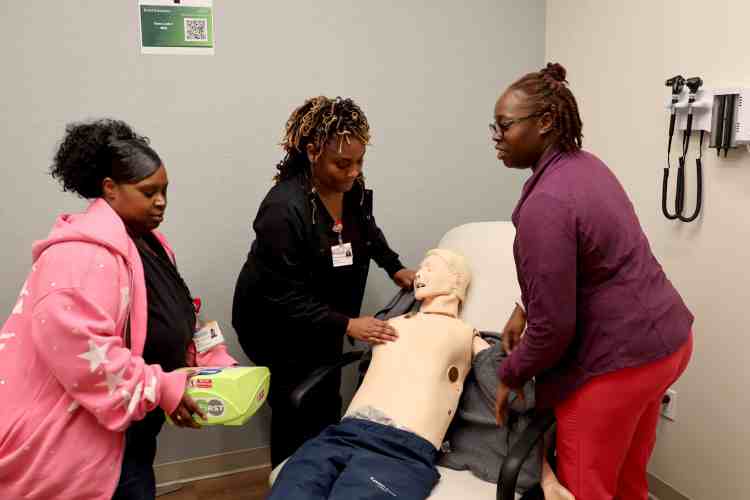
At Cooper Green Mercy Health Services, a recent systems simulation yielded very real results.
UAB Clinical Simulation partnered with leadership at Cooper Green to conduct a systems simulation Sept. 4, giving clinical staff and emergency response teams an opportunity to hone their skills.
To help prepare for the transition, UAB Clinical Simulation partnered with Cooper Green to conduct a series of systems simulations Sept. 4, giving clinical staff and emergency response teams an opportunity to practice critical emergency procedures before the clinic opened.
According to Michelle Bridges, nurse supervisor for Cooper Green Urgent Care and the Code White (Medical Response) Team, the simulation was requested to help the team prepare for emergencies in a newly renovated space.
The exercises presented several emergency scenarios, featuring patients experiencing acute coronary symptoms that progressed to cardiopulmonary arrest. Participants practiced activating local emergency response protocols, performing CPR, locating necessary equipment and coordinating additional support.
“It also was important for us to give the clinical staff the opportunity to practice responding to a code and activating the correct emergency response,” Bridges said.
The exercise also demonstrated how long it could take for responders to arrive from different areas of the building, reinforcing the importance of immediate intervention.
Bridges observed noticeable improvements in staff performance as the exercises progressed, particularly in communication, teamwork and critical thinking. “They also learned how clear and precise communication impacted their teamwork,” she said.
Just two weeks later, that preparation was put to the test.
When a patient experienced a medical emergency in a clinic, staff activated a Code White, notifying the response team that the patient was pulse-less.
Bridges said the team’s initial communication clearly conveyed the severity of the situation. By the time she arrived, approximately one minute after the page, staff had already initiated CPR, applied automated external defibrillator pads, begun providing respiratory support and called 911.
The response reflected the procedures and teamwork practiced during simulation.
“When an actual code similar to the simulation scenario happened two weeks later, upon arrival I witnessed every skill and tool learned at simulation being utilized,” Bridges said.
For Bridges, the experience underscored the value of systems simulation in preparing teams for emergencies, particularly during periods of operational change.
“They were confident in their ability to perform the skills they gained from simulation, and the most important thing is that they felt prepared,” she said.
According to April Belle, director of systems simulation for UAB Clinical Simulation, Bridges’s experience underlines the value of systems simulation.
“The experience illustrates how simulation can help teams navigate environments, strengthen emergency response processes and translate preparation into action when it matters most,” she said.
Interested in bringing simulation to your department or program? Email UAB Clinical Simulation at simulation@uabmc.edu to learn how you can get involved.
UAB Medicine’s Clinical Simulation program offers opportunities for individuals and teams across UAB Medicine and beyond to practice before they deliver care. We encourage all who provide and support patient care to “Sim First.” Together, we can put our patients’ safety first.

0 Comments