
UAB Clinical Simulation’s new systems sim explores complexities of post-acute care
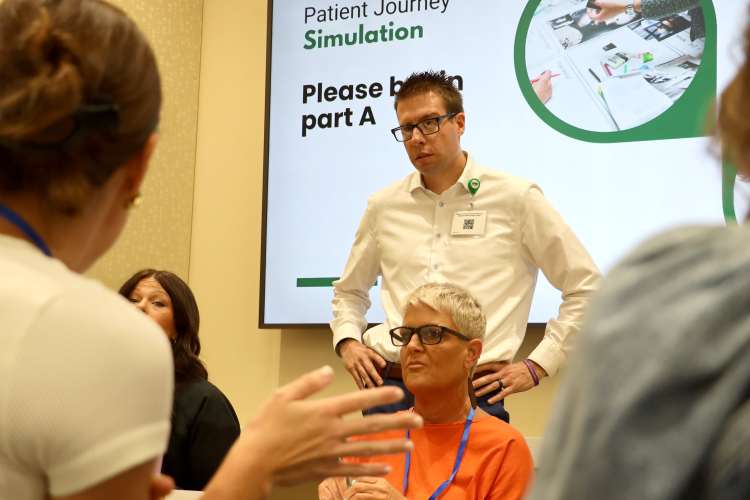
A new simulation aims to navigate a patient’s journey, including all the twists, turns and potential roadblocks found along the way.
UAB Clinical Simulation and UAB Medicine Care Transitions recently piloted a new interprofessional systems simulation designed to help participants better understand the complexities of post-acute care, as well as the perspectives of the many people involved in a patient’s journey.
The Post-Acute Care Patient Journey simulation brought together approximately 80 learners from a variety of disciplines and organizations, including many from outside UAB Medicine. Through a facilitated tabletop exercise, participants assumed the roles of patients and family members, hospital care teams and post-acute care providers as they navigated decisions surrounding a patient’s transition to the next level of care.
“We recognized that healthcare providers frequently make discharge and placement decisions based on information available within their own setting, often without a full understanding of what happens to patients through their care journey,” said Ryan Pindroh, director of Continuing Care Development and Post-Acute Outreach with UAB Medicine Care Transitions.
The simulation was designed to help break down those silos by exposing participants to perspectives, responsibilities and challenges they may not ordinarily encounter in their own roles, Pindroh said.
“One of the most valuable aspects of the simulation is that it allows participants to see the healthcare system through multiple lenses,” Pindroh continued. “Hospital teams, home health clinicians, rehabilitation professionals, skilled nursing facilities, patients and family caregivers often have different priorities, responsibilities and concerns.”
Participants followed the journey of a fictional patient, Mary, during the two-phase simulation, working through decisions involving home health, skilled nursing, long-term acute care and inpatient rehabilitation. Rather than directing those decisions, table facilitators guided participants through the experience before leading small- and large-group debriefings. The exercise was designed to strengthen interprofessional communication, patient- and family-centered decision-making and understanding of post-acute care options.
As a pilot, the simulation also offered its developers an opportunity to see whether participants would begin looking beyond their own roles and settings when considering the complexities of care transitions.
For Pindroh, some of the most telling moments came through the conversations the exercise generated.
“The moments that stood out to me were the open dialogue moments,” he said. “Those were the ‘Ah’ moments that re-enforced the complexity of these decisions, and the challenges that are faced when the next step in a patient’s care journey doesn’t match the patient’s goals.”
Pindroh sees opportunities to build on the pilot by using the simulation as an interdisciplinary training tool across UAB Medicine. Physicians, nurses, therapists, social workers, case managers, home health clinicians, post-acute providers and administrative leaders could use the shared experience to better understand how their respective roles intersect throughout a patient’s journey, he said.
“The simulation creates a shared learning environment where participants can better understand each other’s roles, challenges, and decision-making processes,” Pindroh said. “That shared understanding has the potential to strengthen collaboration far beyond the classroom.”
Interested in bringing simulation to your department or program? Email UAB Clinical Simulation at simulation@uabmc.edu to learn how you can get involved.
UAB Medicine’s Clinical Simulation program offers opportunities for individuals and teams across UAB Medicine and beyond to practice before they deliver care. We encourage all who provide and support patient care to “Sim First.” Together, we can put our patients’ safety first.

0 Comments