
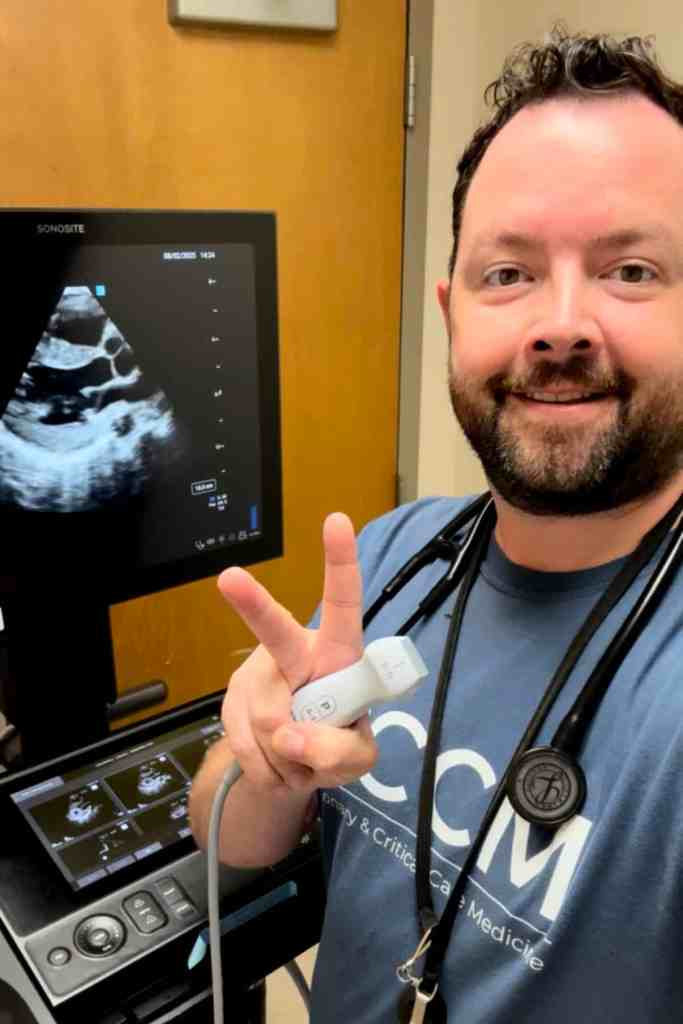
Sim Stars: Nathan Bush, DNP
Sim Stars is a regular feature in UAB Clinical Simulation’s think Sim First newsletter, created to highlight the simulation facilitators who bring learning to life. Each month, we spotlight a partner whose work exemplifies excellence in simulation, collaboration and experiential learning for UAB Medicine.
When it comes to espousing the value of healthcare simulation, Nathan Bush, DNP, doesn’t beat around the bush.
For Bush, an advanced practice provider and supervisor with UAB Medicine’s Division of Pulmonary, Allergy and Critical Care Medicine, simulation is an essential bridge between learning a clinical skill and applying it confidently in patient care.
Bush’s introduction to simulation came through central venous line (CVL) training, where he practiced placing central lines using task trainers in a controlled environment. According to Bush, the experience, along with simulation incorporated into his initial point-of-care ultrasound (POCUS) training, demonstrated the value of hands-on education.
“Simulation gives providers the opportunity to build both competence and confidence without placing patients at risk,” he said. “In critical care where I primarily practice, clinicians often have to perform complex procedures and make decisions quickly, and this preparation can ultimately lead to safer patient care.”
Today, Bush leads CVL training and has developed a POCUS course, helping learners refine procedural skills while understanding their clinical applications.
Both experiences combine hands-on practice with realistic clinical scenarios, encouraging participants to think beyond the mechanics of a procedure.
“That clinical context is especially important because it helps learners understand not only how to perform a procedure or examination, but also why the skill matters, when to use it and how it can influence patient care,” he said.
Some of Bush’s most rewarding moments come when learners share how their simulation experiences have translated into clinical practice. He recalled watching a learner successfully place a central line for the first time while drawing directly on techniques practiced in the sim lab. Meanwhile, experienced clinicians have returned to simulation to refresh infrequently used skills or incorporate newer techniques, such as ultrasound needle tracking, he said.
Bush has witnessed similar successes with POCUS, with providers describing how ultrasound imaging helped them reach diagnoses more quickly or adjust patient management. “These moments show that simulation is valuable not only for learning a skill for the first time, but also for reinforcing and advancing skills throughout a clinician’s career,” he said.
Unlike traditional classroom instruction, Bush believes simulation challenges learners to apply knowledge, make decisions and adapt to unexpected situations while receiving immediate feedback.
For aspiring simulation facilitators, he emphasizes the importance of understanding the clinical context surrounding a skill and breaking complex procedures into manageable steps.
“Steps that seem obvious to an experienced clinician may not be obvious to a new learner,” Bush said. “Teaching those finer details not only strengthens the simulation experience but often deepens your own understanding of the skill.”
Bush also suggested that facilitators look to another source for different perspectives and opportunities to improve future sessions. “I would also encourage new facilitators to expect to learn from their learners,” he said.
UAB Medicine’s Clinical Simulation program offers opportunities for individuals and teams across UAB Medicine and beyond to practice before they deliver care. We encourage all who provide and support patient care to “Sim First.” Together, we can put our patients’ safety first.

0 Comments