
Sim Stars: Brittany Kelly
Sim Stars is a regular feature in UAB Clinical Simulation’s think Sim First newsletter, created to highlight the simulation facilitators who bring learning to life. Each month, we spotlight a partner whose work exemplifies excellence in simulation, collaboration and experiential learning for UAB Medicine.

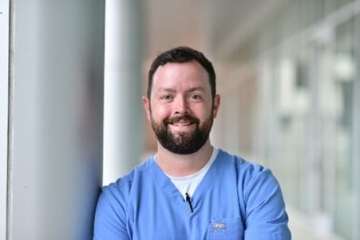
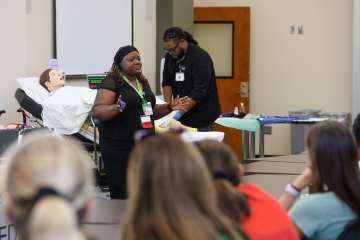
Although UAB Mobile Simulation is always on the move, facilitator Brittany Kelly has built a solid foundation for simulation-based learning at Lakeland Community Hospital in Haleyville, Ala.
An education/employee health nurse at Lakeland, one of the Alabama Rural Health Collaborative partner institutions served by Mobile Simulation, Kelly acknowledges that simulation offers something a classroom alone cannot: the opportunity to put knowledge into practice before facing a similar situation with a patient.
Kelly, education/employee health nurse at Lakeland, one of the Alabama Rural Health Collaborative partner institutions served by Mobile Simulation, acknowledges that simulation offers something a classroom alone cannot: the opportunity to put knowledge into practice before facing a similar situation with a patient.
Kelly has worked with UAB Mobile Simulation for about five years, helping bring sim-based education to health-care professionals in her community. A UAB alum, she said the Mobile Simulation program offers a natural way to maintain her connection with the university while supporting meaningful educational opportunities close to home.
“I became interested in health-care simulation because of the opportunity it provides for hands-on learning in a safe environment,” Kelly said. “In healthcare, there are many situations where being able to practice, make decisions and work through challenges before encountering them in a real patient-care setting can make a significant difference.”
At a rural health-care facility, Kelly particularly values scenarios that challenge participants to communicate, think critically and work together through situations they may not routinely encounter. Watching a team become increasingly comfortable as a scenario unfolds and seeing individual learners begin to trust their own abilities are among the most rewarding aspects of facilitating for her.
“Some of the most memorable moments for me are when you can see a learner gain confidence,” Kelly said. “Someone may begin a simulation hesitant or unsure of themselves, but as the scenario progresses, you see them begin to trust their training, communicate more confidently and take the lead.”
That opportunity to learn through experience is also what Kelly believes distinguishes simulation from traditional classroom instruction.
“Traditional classroom instruction gives learners the foundation and knowledge they need, but simulation allows them to apply that knowledge in a realistic environment,” she said. “It also gives them a safe place to make mistakes and learn from them without putting an actual patient at risk. I think experiencing a simulation firsthand often makes the lesson more memorable and can give learners greater confidence when they encounter a similar situation in real patient care.”
For new simulation facilitators, Kelly emphasizes creating an environment where learners feel comfortable participating, asking questions and reflecting openly on their experiences.
“My advice would be to remember that simulation is about creating an opportunity to learn, not creating a perfect performance,” Kelly said. “Most importantly, use the debriefing process to encourage discussion rather than simply telling participants what they did right or wrong. Some of the best learning happens when participants are given the opportunity to reflect on the experience themselves without the criticism.”
UAB Medicine’s Clinical Simulation program offers opportunities for individuals and teams across UAB Medicine and beyond to practice before they deliver care. We encourage all who provide and support patient care to “Sim First.” Together, we can put our patients’ safety first.
0 Comments