
Mental Health Scholars sim builds communication, de-escalation skills
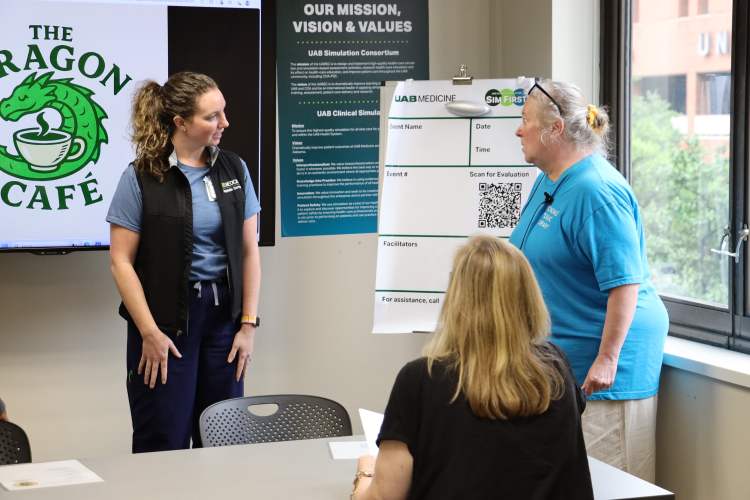
When it comes to strengthening communication, de-escalation and decision-making skills, simulation often comes to mind.
This is especially true for participants in UAB’s Mental Health Scholar program, who were able to put their knowledge to practice through a new simulation this past June.
According to Rachel Purser, R.N., nursing development specialist with UAB’s Center for Psychiatric Medicine, this yearlong professional development program equips healthcare team members with the knowledge, skills and confidence to provide compassionate, evidence-based mental healthcare. Scholars participate in monthly educational sessions, clinical observations and, most recently, simulation experiences before completing a mental health education project within their own work areas.
To facilitate the simulation component of the program, Purser partnered with UAB Clinical Simulation to develop and pilot a mental health sim focused on navigating tense, uncertain encounters with patients.
“The goal of the program is to develop mental health champions who promote compassionate, stigma-free, person-centered care and help create a culture where everyone plays a role in supporting mental health,” Purser said.
The simulation offered the scholars an opportunity to apply concepts introduced throughout the program, including therapeutic communication and verbal de-escalation, in a safe environment before encountering similar situations in actual patient care.
During the experience, participants worked through two scenarios featuring standardized patients experiencing emotional distress and escalating behaviors. Scholars had to assess each situation, recognize signs of escalation, communicate therapeutically, maintain safety and work together to determine appropriate next steps.
Rather than identifying a single “right” response, the scenarios emphasized critical thinking, teamwork and compassionate, patient-centered communication.
“By interacting with standardized patients in realistic scenarios, participants experienced the emotions, uncertainty and complexity of real-life situations while refining their communication, teamwork and clinical judgment in a safe environment,” Purser said.
Guided debriefing following the scenarios gave participants another opportunity to examine their responses, reinforce what they had learned and consider how they could apply those lessons in their own roles.
For Purser, one of the most encouraging results was seeing participants become more comfortable putting those skills into action.
“Many scholars entered feeling unsure of themselves, but as they worked through the scenarios, they were able to put the communication and de-escalation techniques we had discussed throughout the program into practice,” she said.
Purser hopes that confidence extends well beyond the simulated environment.
“We hope they left with greater confidence in their ability to navigate challenging situations, a deeper appreciation for the value of empathy and teamwork, and skills they can confidently carry into their daily interactions with patients, families and colleagues,” she said.
Interested in bringing simulation to your department or program? Email UAB Clinical Simulation at simulation@uabmc.edu to learn how you can get involved.
UAB Medicine’s Clinical Simulation program offers opportunities for individuals and teams across UAB Medicine and beyond to practice before they deliver care. We encourage all who provide and support patient care to “Sim First.” Together, we can put our patients’ safety first.
0 Comments