
Tailormade Trainers: Clinical Simulation partners with Highlands CRNAs to meet learning needs
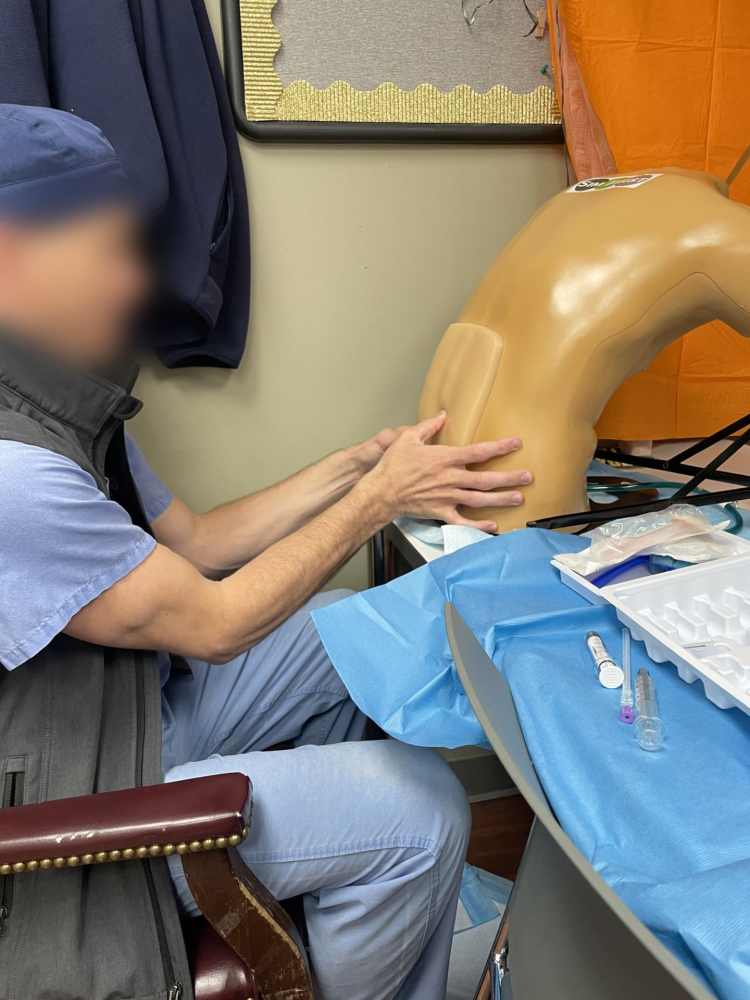
Sometimes, meeting a simulation need means looking beyond what’s already on the shelf.
When Stephanie Hall, CRNA, identified a need for UAB Highlands CRNAs to refresh their spinal anesthesia skills, there wasn’t a trainer already configured for exactly what her team needed. So, Hall partnered with UAB Clinical Simulation to adapt an existing lumbar puncture trainer into a solution tailored to the procedure.
The need emerged as the number of primary hip and knee replacement surgeries at UAB Highlands continued to grow, Hall said. The majority of those procedures are performed under spinal anesthesia, she continued, and student registered nurse anesthetists (SRNAs) have ample opportunities to perform many of the spinal blocks as part of their clinical training.
However, while those opportunities provide valuable experience for students, Hall saw another training need among the experienced CRNAs guiding them.
“The CRNAs often feel like they haven’t actually performed a spinal on their own in quite some time,” she said. “We took this as a great opportunity for our CRNAs to get their hands on a trainer and practice as many times as they needed to feel comfortable with the procedure, as well as guiding the SRNAs when they are performing the procedure.”
Hall knew lumbar puncture trainers existed and believed one could provide the foundation for the training she envisioned. Working closely with UAB Clinical Simulation’s procedural simulation team, including training coordinator Ca’Nesia Jackson, the group modified the setup to more closely replicate what clinicians encounter when administering spinal anesthesia.
“We changed a few things—color of the spinal fluid, height of the fluid bag—to make it more realistic for what we would see in the real world,” Hall said.
Those seemingly small adjustments helped turn an existing resource into a trainer suited to the team’s specific educational goals. The model’s spinous processes are easy to identify, Hall explained, and the trainer can be placed in the ideal position for the procedure, removing one of the variables that can make teaching spinal anesthesia particularly challenging with a patient.
Hall said the training also allowed participants to focus on an aspect of the procedure that can be just as important as the spinal itself: preparation.
“I think learners struggle more with the setup than with the actual procedure,” she said. “We were able to walk them through both parts using the trainer to increase their confidence.”
That confidence may already be translating back to the clinical environment. Hall said the team has seen an increase in CRNAs specifically requesting rooms where they can perform spinal anesthesia to keep their skills current.
For Hall, the development process demonstrated the value of bringing a training need to Clinical Simulation, even when a ready-made solution may not exist.
“UAB Clinical Simulation was great to work with,” Hall said. “Lisa (Bergman) and Ca’Nesia were so helpful and made sure to ask appropriate questions so the trainers were set up exactly how we needed them.”
Hall said Bergman, a founding member of the procedural team, also followed up about ways the trainer could be improved in the future, continuing the collaborative development process beyond its initial use.
The team now hopes to make the spinal anesthesia training an annual opportunity for CRNAs at UAB Highlands.
“We would like to make this a yearly simulation for our group to keep everyone routinely trained on the procedure,” Hall said.
Have a Training Need?
Not every training challenge comes with a ready-made simulation or trainer. If you have an educational need or an idea for improving training, reach out to UAB Clinical Simulation. Our team can work with you to explore possibilities and develop a solution that meets your team’s needs. Learn more by emailing simulation@uabmc.edu.
UAB Medicine’s Clinical Simulation program offers opportunities for individuals and teams across UAB Medicine and beyond to practice before they deliver care. We encourage all who provide and support patient care to “Sim First.” Together, we can put our patients’ safety first.

0 Comments