Italian healthcare leaders explore teamwork at UAB
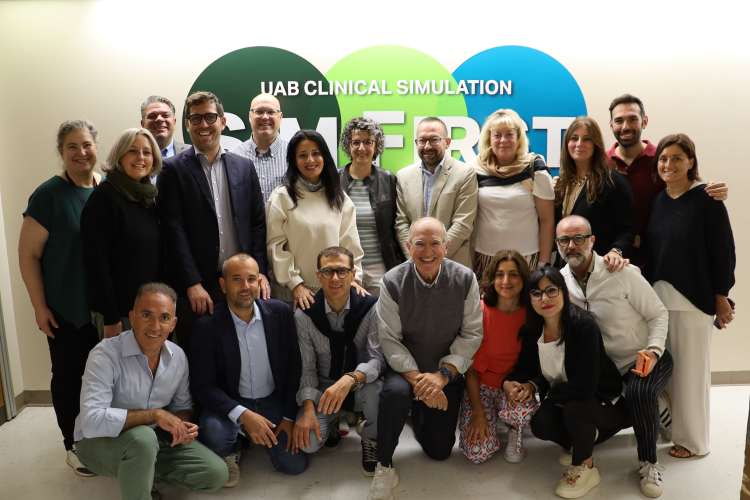
All roads lead to Rome—and Birmingham.
UAB Clinical Simulation recently hosted a cohort of Italian healthcare professionals enrolled in the Executive Master in Healthcare Management at ALTEMS Graduate School of Health Economics and Management, part of the Università Cattolica del Sacro Cuore in Rome, Italy. The group visited UAB in September as part of a weeklong study tour that also included Atlanta.
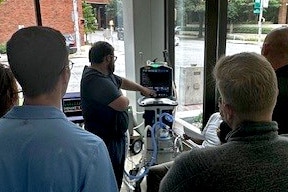
Steven Howard, Ph.D., executive MSHA program director with UAB’s Department of Health Services Administration, coordinated the visit. In Birmingham, the itinerary included a Friday Night at the ER simulation facilitated by Clinical Simulation, a UAB Digital Health tour and meetings with teams at the UAB Emergency Department, Center for Patient Flow, The Kirklin Clinic, Cooper Green Mercy Health Services and the Jefferson County Department of Health. The students also joined UAB Executive MSHA students for a healthcare leadership class.
Luca Giorgio, scientific coordinator of the Executive Master program at ALTEMS, said students hoped to learn from UAB and compare approaches.
“Although healthcare systems differ in how they are organized and financed, many of the challenges we face are shared,” he said. “Learning from other countries and cultures—and exchanging ideas across different healthcare systems—can inspire us to improve our own.”
Interdependence was not a new idea for the students. Giorgio said it is one of the first concepts he teaches. However, putting it into practice is harder. Heavy workloads, time pressure, contractual targets and crowded emergency departments can pull people in different directions, he noted.
“The simulation brought that tension to life, so it felt closely connected to challenges in the Italian healthcare system,” Giorgio said.
He pointed to emergency department crowding and hospital-wide patient flow as especially familiar issues. After the simulation, one visiting student joked that the group had come to save its own department and ended up having to save the whole hospital. The comment drew a laugh, but Giorgio observed that it also captured the simulation’s challenge: decisions in one hospital unit can affect the others.
Giorgio said students have already returned with ideas for improving their own processes and departments.
“First, it’s valuable to keep broadening your horizons, whatever your role or level or experience,” he said. “Second, the simulation showed how stepping outside your usual work setting … can help you see familiar challenges differently. It highlighted the importance of communication, coordinating and making decisions together, rather than taking established ways of working for granted.
“Finally, they’ll remember the warmth and hospitality of the people they met at UAB and in Birmingham. That human connection was an important part of the visit, too.”
UAB Medicine’s Clinical Simulation program offers opportunities for individuals and teams across UAB Medicine and beyond to practice before they deliver care. We encourage all who provide and support patient care to “Sim First.” Together, we can put our patients’ safety first.