
Procedural coaching trains the trainers of trach care
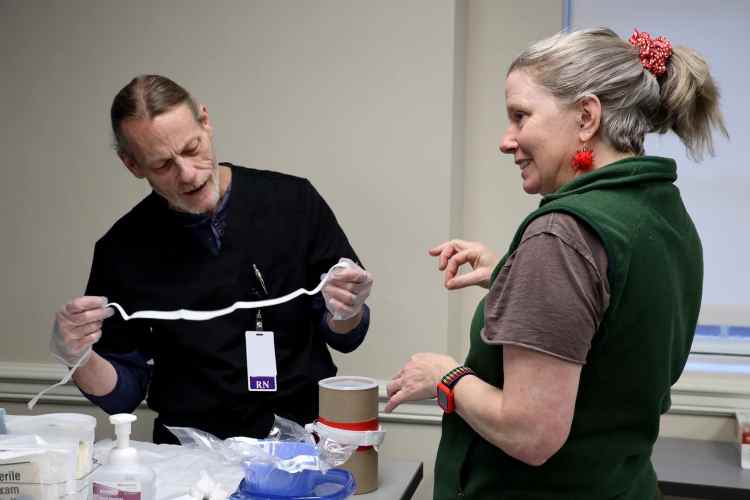
During a recent procedural coaching experience, UAB Clinical Simulation helped deliver a long-term solution for long-term care.
This past February, Clin Sim partnered with UAB Medicine’s Care Transitions Department to facilitate a training session designed to strengthen the simulation programs of five external long-term care facilities. Clinical staff members from each facility traveled to the UAB Clinical Simulation lab to learn how to conduct simulations focused on tracheostomy care.
Participating facilities included Albertville Health & Rehab, Barfield Health Care, Hillview Terrace Health & Rehab, Shelby Ridge Health & Rehab and Talladega Health & Rehab.
According to Ryan Pindroh, director of continuing care development and post-acute outreach with Care Transitions, tracheostomy patients have historically been one of the most challenging populations to place in post-acute care settings, due to the complexity of their care needs.
“They require frequent, specialized and often complex care that can be difficult to manage in environments with higher patient-to-staff ratios,” Pindroh said, adding that this often results in extended lengths of stay in the hospital. “In addition, nursing homes do not have access to the same level of resources found in hospitals, making them heavily dependent on the clinical expertise of their staff to deliver safe and consistent care.”
Thanks to his department’s strong relationships with area long-term care facilities, one facility proactively reached out to ask whether UAB could provide tracheostomy training for their staff.
“Through conversations and collaborations with nursing homes, we found that the primary barrier was not capability, but comfort level,” Pindroh said. “Nursing homes—much like the broader health-care landscape—are constantly evolving. Patients are becoming increasingly complex, and staffing ratios continue to shift. By strengthening their internal simulation programs, nursing homes can better adapt to these changes, enhance staff confidence and competence, and ultimately continue to improve the quality of care they provide.”
Clinical Simulation’s procedural team was up to the task. Procedural simulation typically focuses on helping health-care professionals acquire and maintain technical skills, such as central line placement or ultrasound-guided peripheral intravenous access. In this session, however, the goal was slightly different: teaching educators how to effectively design and facilitate procedural simulations themselves.
Using a combination of everyday household items and clinical supplies, including repurposed oatmeal containers and medical tubing, the team created custom training equipment to replicate a tracheostomy site, so learners could practice care and maintenance before facilitating a similar simulation with their own teams.
“The key message I hope learners took away from this experience is that simulation can be a powerful tool for ongoing education, benefiting both new team members and seasoned staff,” Pindroh said. “Building a strong simulation program doesn’t require extensive resources; it simply requires identifying a need and approaching it with creativity. With thoughtful planning and a willingness to think outside the box, simulation can elevate competency, confidence and the overall quality of patient care.”
Additionally, by strengthening procedural simulation in long-term care settings, staff clinical capabilities are improved, supporting UAB by reducing length of stay and readmission rates, he added.
Pindroh said the learners enjoyed the experience—as did he.
“I truly enjoyed my time working with UAB Clinical Simulation,” he said. “What stood out to me was that ‘no’ was never part of the conversation. It was always, ‘Let’s figure out how to make this work.’ Their can-do attitude, collaboration and unwavering commitment to doing what’s best for the patient came through in everything they did, and it made the entire experience both productive and inspiring.”
To learn how simulation can benefit your own team or department, email simulation@uabmc.edu.
UAB Medicine’s Clinical Simulation program offers opportunities for individuals and teams across UAB Medicine and beyond to practice before they deliver care. We encourage all who provide and support patient care to “Sim First.” Together, we can put our patients’ safety first.
0 Comments