
Critical Care Peri-Op Nursing Sim prepares PACU nurses for high-risk scenarios
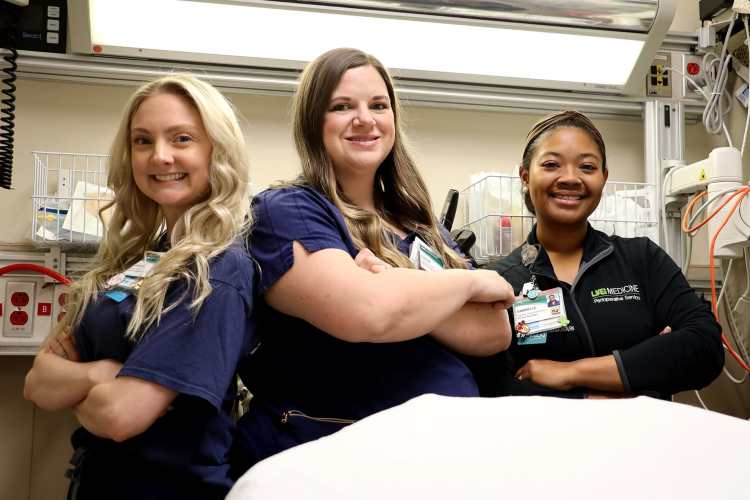
Some of the most critical situations in post-anesthesia care are also the ones nurses encounter the least.
To help prepare staff for those rare but high-risk moments, UAB Clinical Simulation partnered with UAB Medicine’s PreOp/PACU team to host a Critical Care Peri-op Nursing simulation designed specifically for post-anesthesia care unit (PACU) nurses.
Facilitated by Cassandra West, a perioperative new graduate nurse professional development specialist with UAB Medicine, the immersive simulation places learners in realistic scenarios reflecting complex events that can occur in the PACU environment.
“The Critical Care Peri-op Nursing simulations consist of several high-risk PACU scenarios that not all nurses encounter in daily practice,” West said. “Because of the PACU’s size and high patient volume, these situations occur in our environment, but only a limited number of staff are directly involved when they happen. The simulation provides all nurses the opportunity to experience and manage these rare but critical events in a controlled, realistic setting.”
The program itself grew out of feedback from new hires working in PreOp and PACU.
“Over the last several years, PreOp/PACU new hires consistently shared that the hospital’s Critical Care Orientation (CCO) is geared more toward traditional ICU environments rather than the PACU,” West said. “As this feedback continued, it became clear that our nurses needed education tailored specifically to the critical situations unique to PACU care. This led us to develop our own PACU-specific immersive simulation experience.”
During the simulation, learners practice recognizing early warning signs of complications and responding effectively under pressure.
“We hope learners gain increased familiarity with high-risk PACU situations and feel confident in knowing what to do when these scenarios arise,” West said. “The goal is for every nurse to recognize early warning signs, respond effectively and trust their skills when managing critical events.”
According to West, simulation also allows clinicians to experience the emotions and pressures of real-world situations without risk to patients.
“They can experience the emotions, stress and decision-making pressures of critical situations in a safe, supportive environment,” she said.
West added that the partnership with Clinical Simulation played an important role in bringing the course to life.
“The Clinical Simulation team has been incredibly helpful and truly instrumental in the success of this course,” she said. “From the initial planning phase to the operations team managing technology, equipment and audio, each member played a critical role in bringing our vision to life. Their expertise, support and collaborative approach helped shape a high-quality simulation experience that strengthens education for all our learners.”
To learn how simulation can benefit your own team or department, email simulation@uabmc.edu.
UAB Medicine’s Clinical Simulation program offers opportunities for individuals and teams across UAB Medicine and beyond to practice before they deliver care. We encourage all who provide and support patient care to “Sim First.” Together, we can put our patients’ safety first.
0 Comments