
Simulation empowers UAB Wound Scholars
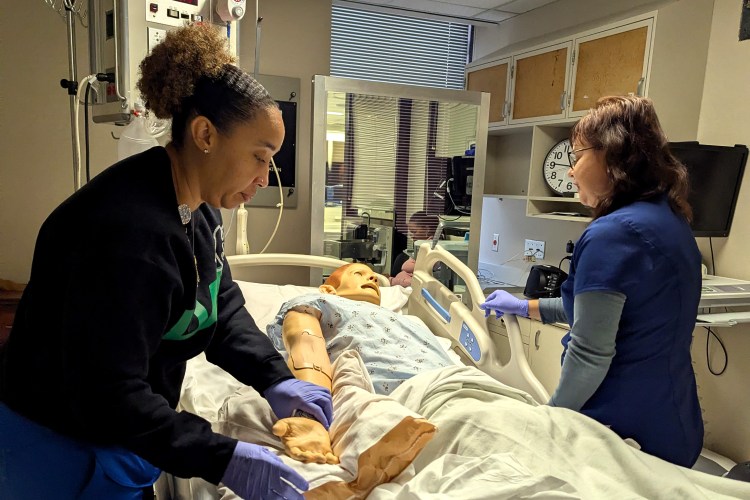
Wound care can be a sore subject.
Fortunately, through collaboration with UAB Clinical Simulation, UAB’s Wound Scholar Program continues to empower frontline staff to meet the growing need for wound care prevention—and treatment—at the bedside.
Offered through UAB’s Department of Interprofessional Practice and Training (DIPT), the program benefits patient care by emphasizing the prevention of pressure injuries through a blend of coursework, clinical experiences, mentorship and simulation, program development manager Jada Finley explained.
“Preventing pressure injuries helps reduce patient suffering and avoids the potential for permanent harm associated with more severe injuries,” Finley said. “Wound Scholars are trained to preserve skin integrity, recognizing that the skin serves as the body’s first line of defense.”
According to Finley, simulation helps reinforce this, playing a crucial role in Wound Scholars’ training.
“It allows learners to apply knowledge gained from lectures and skills days in a safe, hands-on environment,” she said. “Discussing pressure injury prevention in a conference room is fundamentally different from physically interacting with a manikin and actively implementing prevention strategies. Simulation provides learners with real-time practice, along with just-in-time coaching and feedback, which deepens learning and builds confidence in clinical decision-making.”
Although the scenarios are simulated, the results are very real. Finley can attest to seeing the impact of simulation first-hand.
“One particularly memorable moment involved a scholar using the teach-back method while educating a standardized caregiver/family member,” Finley said. “She clearly explained how and why a patient’s heels should be offloaded, then encouraged the family member to perform the technique using heel protector boots. Throughout the activity, she provided coaching and positive reinforcement. Her goal was not only to support the caregiver during the hospital stay, but also to build confidence in their ability to safely offload the patient’s heels after discharge.”
Originally created by UAB’s Wound, Ostomy and Continence Team, the Wound Scholar program was “rebooted” by DIPT after the COVID-19 pandemic to align more closely with UAB’s established Geriatric Scholar Program, said David James, program development manager with DIPT.
Since then, the program has expanded to include two tracks—Advocate and Patient Support, the latter intended for non-licensed scholars.
“Importantly, both tracks continue to come together during simulation experiences to deliver care as an interdisciplinary team,” Finley said. “Additionally, we have seen an increase in participation from ambulatory settings, which is especially valuable, as these learners help ensure patients are set up for success in the outpatient environment.”
Regardless of track, Finley said her overarching goal is for all learners to feel empowered to serve as advocates for wound and skin care best practices. Upon graduation, she continued, each scholar is expected to embody the advocate role by:
- Providing education to patients and peers
- Serving as liaison between the Wound, Ostomy and Continence Team and their respective unit or department
- Performing basic data collection to monitor compliance with wound and skin care best practices
- Demonstrating interprofessional collaboration and communication
“Simulation serves as a cornerstone of the learning experience,” James said. “It bridges classroom knowledge with real-world clinical practice.”
To learn more about the Wound Scholar Program and DIPT, visit here. To learn how simulation can benefit your own team or department, email simulation@uabmc.edu.
UAB Medicine’s Clinical Simulation program offers opportunities for individuals and teams across UAB Medicine and beyond to practice before they deliver care. We encourage all who provide and support patient care to “Sim First.” Together, we can put our patients’ safety first.
0 Comments