
Surplus supply donation turns trash into training
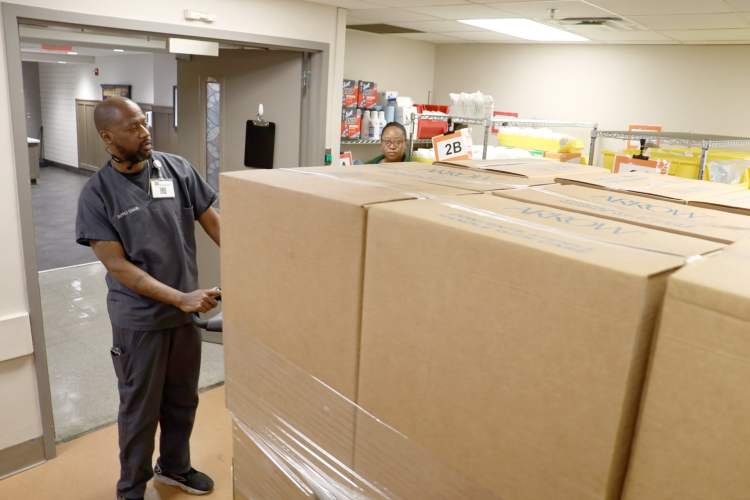
A recent donation of surplus central venous line (CVL) kits is turning trash into training and training into improved patient outcomes.
When Sam Dodd, materials management support services manager for UAB Medicine, informed UAB Clinical Simulation that his department received a large quantity of CVL kits that would not be able to be used before their expiration date, procedural simulation’s Lisa Bergman was more than happy to find them a home.
While the kits aren’t an exact match for those used in simulation, they contain many of the same components, Bergman explained. Rather than letting them go to waste, the procedural simulation team is instead breaking them down and rebuilding them into kits that align with their curriculum.
It’s a practical solution, she said, and one that carries both financial and educational benefits.
“Expired supplies have already been purchased and are often not able to be returned, so using them instead of throwing them away and buying more for sim makes sense financially,” she said.
But the impact goes beyond cost savings. Donations like these can also expand what’s possible within simulation itself, sometimes even sparking new ideas for training.
“There have been times that donations of supplies have prompted us to think about possibilities for new simulation development,” Bergman said. “We also can use supplies that are donated as components for trainers or simulators that we build for use at UAB.”
There’s also a clear sustainability benefit, which can add up quickly.
“Health care generates a huge amount of trash,” Bergman said. “Anything we can do to decrease the amount of material that is discarded is a win.”
In this case, each repurposed kit helps reduce waste in a measurable way.
“Each kit that we are disassembling and repurposing will prevent an additional 1.9 pounds of trash generation,” Bergman said.
For learners, the benefit is just as tangible. Using real clinical materials—even repurposed ones—helps create a more realistic and meaningful training environment.
“Donations of expired products allow us to match the supplies that are used clinically in the simulated environment, which helps provide a more meaningful training experience,” Bergman said.
And for departments with unused or expired supplies, the process to contribute is straightforward. Any expired or unused supplies can be dropped off in the UAB Clinical Simulation lab near QBT 338. Potential donors may also email inquiries to simulation@uabmc.edu.
UAB Medicine’s Clinical Simulation program offers opportunities for individuals and teams across UAB Medicine and beyond to practice before they deliver care. We encourage all who provide and support patient care to “Sim First.” Together, we can put our patients’ safety first.
0 Comments