
Radiology sims sharpen the image
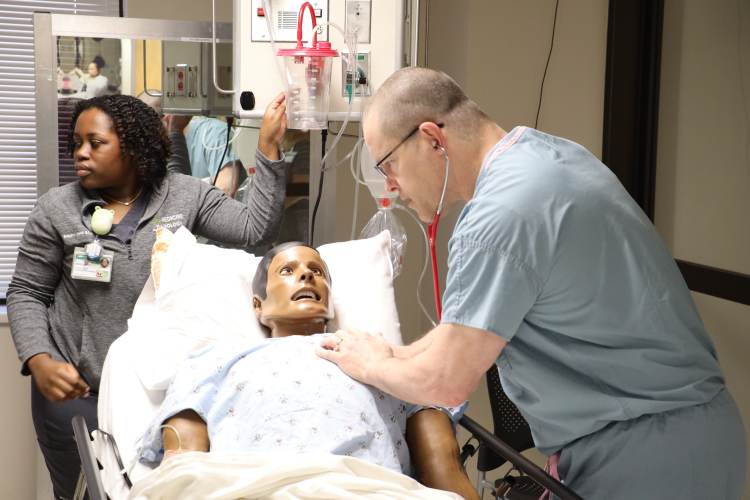
In radiology, an image problem can mean something entirely different.
When a patient has a reaction to contrast, the picture changes quickly, and teams must respond just as fast. Recent radiology simulations hosted by UAB Clinical Simulation focused on exactly those moments, giving staff the chance to practice how they communicate, lead and act when a routine scan takes a turn for the unexpected.
The goal? “Making sure staff—radiologists, technologists—all know what to do when there’s a patient having a reaction, who to call, how to handle it… communication, teamwork, establishing a leader,” said Ashley Thomas, director of quality and operations with the UAB Department of Radiology.
As learners worked through the scenarios, takeaways ranged from technical adjustments to more foundational skills.
For one radiologist, Thomas explained, that meant rethinking how to properly administer medication through an IV. For a technologist, she continued, the focus was on communication, ensuring the radiologist had clear, timely information to guide decisions.
“Her takeaway was better communication of what’s going on so she can assist that radiologist with making his decision,” Thomas said. “And another takeaway… just being more confident.”
That confidence carries beyond the simulation lab, said Carla Gover, radiology clinical educator, often shaping how learners approach real clinical situations afterward.
“The techs and the radiologists leave this scenario and go back to their department, and they realize how to handle it,” she said. “So, these frequent conversations just have them prepared for the real thing.”
Simulation also highlights something learners don’t always get from a textbook, namely how to adapt when reality doesn’t follow the script.
“You can’t always match reality with the book,” Thomas said. “Book is book, but reality is based off the patient. You have to do what’s best for your patient.”
That idea came into focus during scenarios involving seizures and IV access, where learners had to adjust their approach in real time rather than rely solely on standard guidance.
For Thomas, that’s what makes simulation such a valuable partner for radiology, as it offers a psychologically safe environment to work through challenges, build confidence and improve before those moments actually happen.
“Simulation puts my department in a situation where our team can grow and learn,” Thomas said.
Interested in bringing simulation to your department or program? Email UAB Clinical Simulation at simulation@uabmc.edu to learn how you can get involved.
UAB Medicine’s Clinical Simulation program offers opportunities for individuals and teams across UAB Medicine and beyond to practice before they deliver care. We encourage all who provide and support patient care to “Sim First.” Together, we can put our patients’ safety first.
0 Comments