
Brittney Clark named anesthesia department’s simulation director

For Brittney Clark, M.D., simulation sits at the intersection of clinical care and education.
“Simulation fits perfectly, especially in anesthesia, where preparation and teamwork are critical,” said Clark, director of anesthesia simulation and assistant professor in the Department of Anesthesiology and Perioperative Medicine.
Only recently appointed director of anesthesia simulation for the department, Clark steps into a role focused on preparing clinicians for the kinds of moments that don’t allow for trial and error.
Her path to the role reflects that focus. Clark chose anesthesia for its fast pace and the opportunity to make high-impact decisions in real time. Over time, simulation became a natural extension of that work.
“My interest in simulation grew from the need to safely practice rare but critical events,” she said.
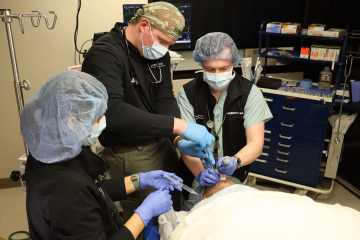
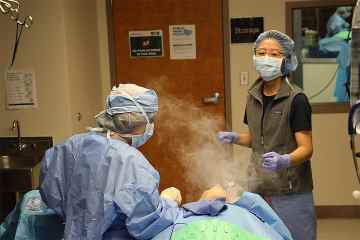
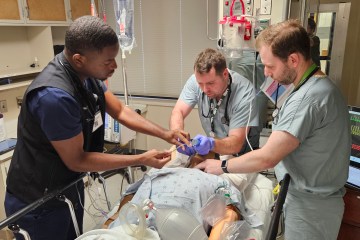
Those high-risk, low-frequency scenarios are at the core of anesthesia-led simulation. Designed to mirror rapidly evolving clinical situations, they challenge learners to think clearly, communicate effectively and function as a coordinated team under pressure.
“Anesthesia-led simulation focuses on high-risk, rapidly evolving situations that require precision and strong teamwork,” Clark said. “It emphasizes crisis management skills like decision-making and communication, often in interprofessional settings.”
That interprofessional approach is made possible through a close partnership between the Department of Anesthesia and UAB Clinical Simulation.
“It’s a highly collaborative partnership,” Clark said. “Anesthesia provides clinical expertise, and the simulation center offers the tools and structure for training.”
In practice, that collaboration means anesthesia faculty and simulation educators work side by side to design and facilitate experiences tailored specifically to their learners. The result is training grounded in real clinical workflows and team dynamics.
As director, Clark’s priorities center on expanding interdisciplinary training, strengthening debriefing practices and ensuring simulation remains aligned with clinical needs.
“The goal is to improve patient safety by preparing clinicians and teams to perform confidently and effectively in high-stakes situations,” she said.
At its core, she added, the work is about readiness, giving teams the opportunity to practice, refine and respond before it matters most.
To learn how simulation can benefit your department or program, email simulation@uabmc.edu.
UAB Medicine’s Clinical Simulation program offers opportunities for individuals and teams across UAB Medicine and beyond to practice before they deliver care. We encourage all who provide and support patient care to “Sim First.” Together, we can put our patients’ safety first.
0 Comments