
Girl Scouts earn their ‘Sim Badge’ at UAB Clinical Simulation
Girl Scouts earn badges for mastering new skills, from outdoor survival to community service.
But on Feb. 16, a group of scouts from across North-Central Alabama visited the UAB Clinical Simulation lab to work toward a different kind of achievement—a hands-on exploration of careers in health care.
Through a pilot simulation experience designed to spark curiosity about the medical field, scouts interacted with an interprofessional team of health-care professionals from various disciplines and departments.
Intended for high schoolers, the experience itself was facilitated through a partnership between UAB Medicine’s Office of Employee Access and Workforce Development, the Growth, Resources and Outreach for Women (GROW) employee resource group and UAB Clinical Simulation, with collaboration from staff in anesthesia, nursing, obstetrics and gynecology, radiology and respiratory care.
“For workforce development, one of our strategies is an ‘outside-in’ approach, which focuses on providing opportunities that help people get their foot in the door at UAB,” workforce development manager Tiffany Bishop said, adding that youth outreach is an important part of that strategy. “We want to introduce students to meaningful careers that are in high demand and help build our future workforce pipeline.”
Working with Clinical Simulation allowed Bishop and company to showcase health-care careers previously unfamiliar to the scouts, such as imaging and respiratory therapy. Rather than have the scouts tour the medical campus to visit various departments, which Bishop admitted would have been time-consuming, UAB Clinical Simulation offered its lab as a one-stop shop, facilitating multiple experiences in one central location.
“Simulation gave the scouts the opportunity to learn by doing, which is one of the core principles of the Girl Scouts program,” Bishop said. “It also allowed them to discover career paths they may not have known about before, and Clinical Simulation created a space where they could try things out and explore.”
Throughout the afternoon, scouts rotated through a series of interactive stations designed to highlight different corners of the health-care field.
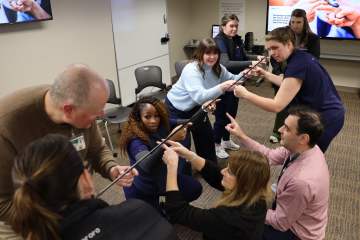
One activity focused on teamwork in health care through a deceptively simple exercise known as the Helium Stick. Working together, scouts attempted to lower a lightweight rod to the ground using only their index fingers. The stick has a notorious tendency to rise instead of fall, leading to both laughter and frustration while underscoring an important lesson about communication, coordination and teamwork in clinical environments.
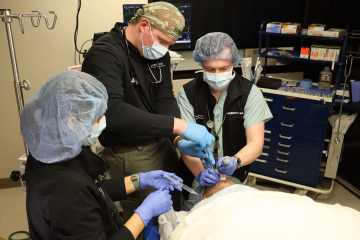
Another station introduced scouts to perioperative careers, including the collaborative work of certified registered nurse anesthetists (CRNAs) and respiratory therapists. After learning about airway anatomy and the equipment used to support breathing during procedures, scouts had the opportunity to experiment with airway management tools, such as bag-valve masks, and airway trainers used for both direct and video-assisted intubation.
At the imaging careers station, scouts learned about the many professionals who work in imaging technology and the wide range of vocational pathways available within the field. Facilitators also highlighted the variety of imaging modalities that allow specialists to focus on different areas of patient care. Scouts were then introduced to ultrasound using Vimedix simulators and were able to visualize the vasculature in their own forearms during a live scan.
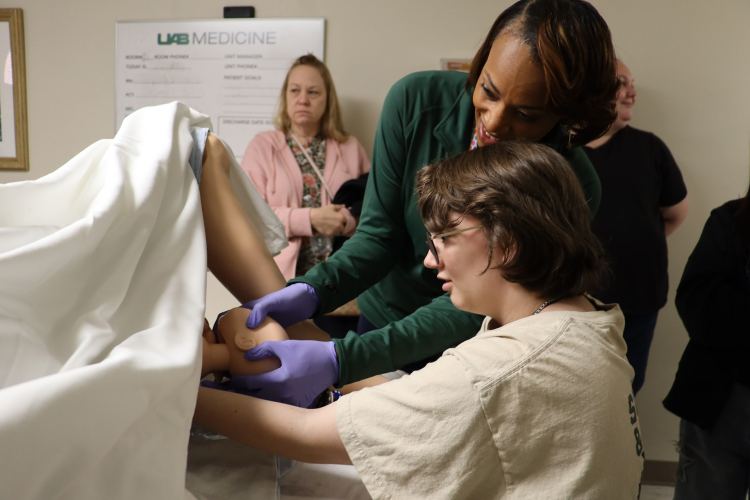
Scouts also explored maternal and fetal health careers, where they were introduced to the many professionals involved in supporting mothers and newborns. The session included a hands-on, immersive demonstration using Sim Mom, a high-fidelity maternal manikin capable of simulating childbirth. The experience walked scouts through the basics of uncomplicated delivery and immediate newborn care.
Finally, scouts experienced the role of education in health care, learning how simulation itself is used to train medical professionals. Through a rapid-cycle deliberate practice exercise, they were introduced to the “First Five” steps in responding to a medical emergency, including checking responsiveness, activating emergency services, retrieving and placing an AED and initiating chest compressions.
According to Bishop, some students said afterward that they were now interested in careers they hadn’t previously considered, such as radiologic technologist or respiratory therapist.
“You don’t know what you don’t know, and simulation created a space where they could try things out and explore,” Bishop said. “This is also the stage when students start hearing the question, ‘What do you want to be?’
“Many young people may already have a general interest in health care, but they don’t always know what specific paths exist. Providing hands-on exposure and real-world experiences during this time can help them explore their interests and potentially solidify their decision to pursue a health-care career.”
The Girl Scouts organization encourages participants to discover, connect and take action, and the simulation event already checked the first two boxes. Bishop hopes the students will take the next step by pursuing education and training in health care—and that the pilot will be the first of many similar opportunities to come.
But one moment from the day stood out to her the most.
“I expected the students to be engaged, but the parents, chaperones, employees and even myself were just as energized by the experience,” she said. “It was one of those cup-filling moments—being able to come to work and do something that energizes and inspires everyone involved.”
To learn how simulation can benefit your own team or department, email simulation@uabmc.edu.
UAB Medicine’s Clinical Simulation program offers opportunities for individuals and teams across UAB Medicine and beyond to practice before they deliver care. We encourage all who provide and support patient care to “Sim First.” Together, we can put our patients’ safety first.
0 Comments