
Quality Academy, Clinical Simulation partner to strengthen systems
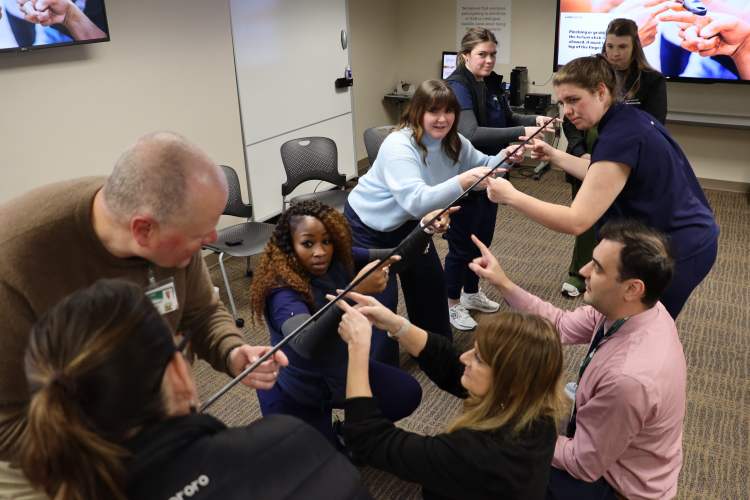
When UAB Medicine leaders set out to strengthen quality improvement from within, they knew it would require more than a series of lectures.
It would require rigor.
The first cohort of the Quality Academy launched in 2013 after leadership recognized that building sustainable expertise in improvement science meant training internally rather than relying on outside consultants—with UAB Clinical Simulation playing an integral part.
To ensure academic depth and structure, UAB Medicine partnered with the UAB School of Health Professions’ Department of Health Services Administration to develop a formal graduate certificate program: the Graduate Certificate in Healthcare Quality and Safety, also known as Quality Academy.
“So, we knew there would be rigor behind what we were doing,” said Leslie Hayes, M.D., associate chief quality officer of UAB Hospitals and faculty member in the Department of Health Services Administration. “We are training leaders and future leaders how to identify and ultimately solve problems at the point of care delivery.”
Thirteen years later, more than 600 leaders across UAB Medicine have completed the program. The current cohort is the largest to date at more than 50 participants, Hayes said, and includes physicians, nurses, pharmacists, therapists and administrative leaders, reflecting the reality that quality improvement is a team effort.
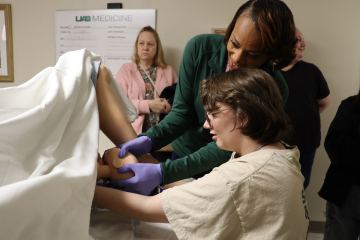
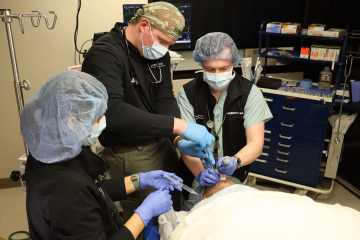
From the beginning, UAB Clinical Simulation has served as a key experiential partner in the program, helping translate improvement science into action through simulation experiences.
“Health-care simulation plays a vital role in the Quality Academy,” Hayes said, noting that one of the program’s in-person sessions is focused solely on simulation and how Quality and Patient Safety can partner with UAB Clinical Simulation.
That partnership reflects a broader philosophy behind the program.
“In order to provide stellar clinical outcomes, QI was not optional,” said Scott Buchalter, M.D., chief quality education officer for UAB Hospitals and faculty member in the Department of Health Services Administration.
Each interdisciplinary cohort takes on strategically selected projects aimed at improving care delivery and patient outcomes. According to Hayes and Buchalter, past efforts have led to measurable reductions in post-operative respiratory failure and helped lay the foundation for enhanced diabetes care coordination across the continuum.
Quality Academy’s distinction lays in its practical application. Participants do not simply learn improvement tools—they use them, Buchalter said. Teams map real processes, analyze variation and pilot solutions, often outside their own clinical specialties. In doing so, Hayes said, they learn that expertise is less about familiarity with a specific department and more about disciplined curiosity.
“Sometimes when you don’t know the process, it actually frees you up to be more curious,” she said.
That curiosity becomes tangible during the program’s simulation experiences.
Because quality improvement is inherently process-driven, simulation offers a powerful way to see those processes in action. Participants engage in immersive disaster exercises, tabletop scenarios and rapid-cycle deliberate practice designed to surface system gaps and strengthen teamwork.
“There’s almost no better way to really understand what you don’t know about the process than to simulate the process,” Buchalter said.
Simulation is used not only to identify breakdowns but also to test potential solutions before they are implemented, he explained, adding that teams can map workflows, observe communication dynamics and refine changes in a controlled environment, thus strengthening both confidence and coordination before those changes reach real patients.
Over time, Hayes and Buchalter watch participants move from uncertainty to ownership. The growth is gradual but unmistakable, Buchalter said, as teams recognize their ability to influence outcomes in meaningful ways.
And when teams practice together, patients ultimately benefit.
To learn more about Quality Academy, visit here.
UAB Medicine’s Clinical Simulation program offers opportunities for individuals and teams across UAB Medicine and beyond to practice before they deliver care. We encourage all who provide and support patient care to “Sim First.” Together, we can put our patients’ safety first.

0 Comments