
Sim OR undergoes renovation procedure
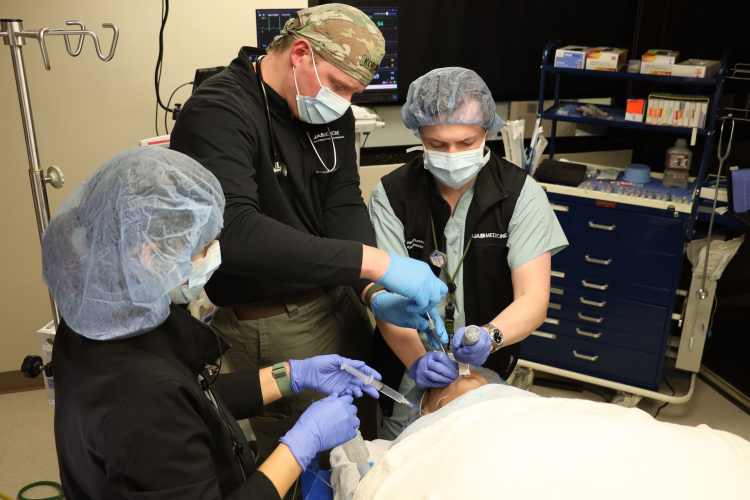
UAB Clinical Simulation’s simulated operating room is undergoing a procedure of its own.
Typically reserved for health-care simulations involving those who provide care in the operating room setting, the simulated OR is designed to offer an immersive, authentic experience for learners. And following recent renovations, that experience is set to become even more realistic and dynamic.
The improvements started with a manikin. According to Andrea Hammett, senior simulation coordinator specializing in anesthesia simulation, the purchase of a new manikin to replace an older model led to an entire OR transition.
“The transition was strategic to allow the anesthesia simulationists to become acclimated to the new manikin, as well as training,” she said.
Once a timeline was determined, Hammett and members of the Clinical Simulation team met with the Department of Anesthesia and Perioperative Medicine’s sim team to devise a plan to make the space more user-friendly and functional.
“This allowed us to make changes within the space to allow for more room and functionality,” Hammett said.
For instance, now, learners needn’t navigate around hanging gas lines and can move freely around the simulated patient.
“This change will feel more natural to the way they work in their own environments,” she said. “The space itself will allow for more OR-based simulations and, in hopes of more simulations, particularly low-volume, high-risk scenarios to allow for (Crisis Resource Management) principles to be used and practiced in a safe space.”
James Hunter, M.D., associate professor in UAB’s Department of Anesthesiology and Perioperative Medicine, frequently facilitates simulation in the simulated OR.
“Clinical Simulation offers a backbone of equipment and personnel experienced in medical simulation, crisis management, simulation scenario creation and debriefing,” he said.
Hunter stressed the value of practicing in a realistic setting, noting that it’s invaluable in teaching learners how to navigate and manage a crisis “efficiently and effectively.”
Andrew Hackney, M.D., facilitator and assistant professor in the Department of Anesthesiology and Perioperative Medicine, agrees.
“The main point of many of our simulation scenarios is to place residents in (realistic) situations where they must manage rare clinical events they may not encounter during residency,” he said. “These scenarios also aim to create an environment where learners must problem-solve quickly and calmly under pressure. Most simulations are not only about solving the clinical issue but also about mastering crisis management.”
To learn how simulation can benefit your own team or department, email simulation@uabmc.edu.
UAB Medicine’s Clinical Simulation program offers opportunities for individuals and teams across UAB Medicine and beyond to practice before they deliver care. We encourage all who provide and support patient care to “Sim First.” Together, we can put our patients’ safety first.
0 Comments