
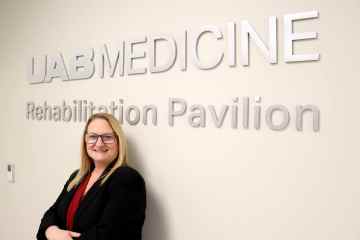
Sim Stars: Audra Boyles, R.N.

Sim Stars is a regular feature in UAB Clinical Simulation’s think Sim First newsletter, created to highlight the simulation facilitators who bring learning to life. Each month, we spotlight a partner whose work exemplifies excellence in simulation, collaboration and experiential learning for UAB Medicine.
As a facilitator and stroke program coordinator with the Department of Neurology at UAB Hospital, Audra Boyles, R.N. brings both clinical precision and innovative thinking to health-care simulation—particularly in the realm of stroke education.
Her work focuses on ensuring consistency, accuracy and confidence in neurologic assessment across nursing teams, with virtual reality (VR) simulation playing a central role.
“As a stroke coordinator, my involvement in health-care simulation was driven by the need to ensure consistent, accurate NIH Stroke Scale (NIHSS) assessments across nursing staff,” Boyles said. “Virtual reality simulation emerged as an innovative way to standardize NIHSS education, allowing nurses to practice neurologic assessments in immersive scenarios that closely mirror real stroke presentations.”
That realism is a key reason Boyles gravitates toward VR-based simulations. She most enjoys facilitating stroke-focused VR experiences that allow nurses to encounter a wide range of neurologic deficits, apply standardized NIHSS scoring and see firsthand how those assessments guide clinical decision-making.
“These simulations allow nurses to assess a wide range of neurologic deficits, apply standardized scoring and understand how NIHSS results directly influence clinical pathways, such as stroke alerts and treatment eligibility,” Boyles said.
From her perspective as a stroke coordinator, Boyles said, VR simulation plays a critical role in building “system-wide competency, consistency and confidence in neurologic assessment.”
Some of the most meaningful moments she has witnessed come not from the technology itself, but from learners’ reactions to it. Boyles said she often sees initial hesitation from nurses who are unfamiliar with VR and unsure what to expect.
“One of the most memorable moments has been the feedback from nursing staff experiencing virtual reality stroke simulation for the first time,” she said. “Many nurses initially express hesitation or anxiety about using VR technology, expecting it to be complicated or uncomfortable.”
That hesitation tends to fade quickly.
“After completing the NIH Stroke Scale simulation, they consistently report that the experience was far less intimidating than anticipated and significantly more engaging than traditional online training modules,” Boyles said.
Boyles added that engagement is what truly sets simulation apart from traditional classroom instruction.
“Virtual reality simulation allows nurses to move beyond passive learning and actively apply the NIHSS in realistic clinical scenarios,” she said. “Unlike traditional online learning modules, VR simulation promotes clinical judgment, pattern recognition and decision-making under time constraints.”
For stroke education in particular, she said this approach strengthens knowledge retention and assessment reliability, helping support organizational goals related to stroke metrics and quality outcomes.
For those just beginning their journey as simulation facilitators, Boyles emphasized the importance of grounding innovation in evidence-based practice. “I recommend grounding scenarios in evidence-based tools, such as the NIH Stroke Scale, and aligning them with institutional stroke protocols,” she said.
Becoming comfortable with VR technology, setting clear learning objectives and prioritizing structured debriefing are all essential, she said. “The goal is not only skill acquisition but also standardization of practice and improved patient outcomes through effective education.”
UAB Medicine’s Clinical Simulation program offers opportunities for individuals and teams across UAB Medicine and beyond to practice before they deliver care. We encourage all who provide and support patient care to “Sim First.” Together, we can put our patients’ safety first.

0 Comments