
New airway fire sim targets rare, high-risk OR emergency
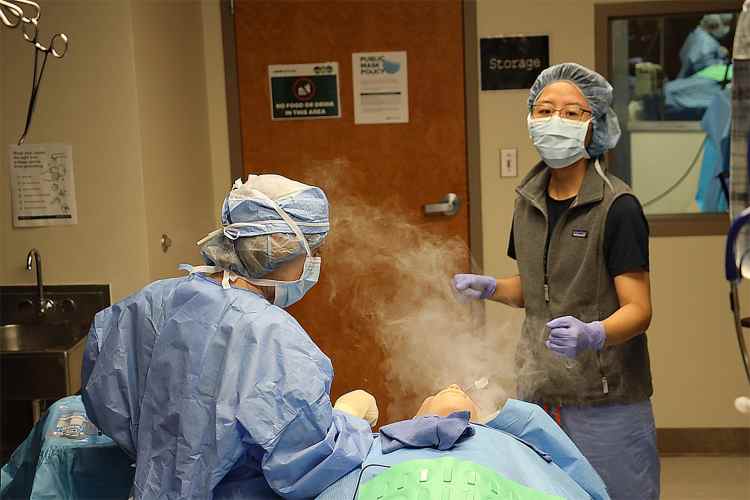
UAB Clinical Simulation recently piloted a new pilot simulation focused on one of the operating room’s most serious, but least frequently encountered, emergencies: airway fires.
The initiative was sparked by an institutional priority and resulted in a faculty-driven project aimed at preparing anesthesia learners for managing rare, high-risk events.
Development was led by Dr. Paul Piennette, facilitator and associate professor of anesthesiology, in collaboration with senior simulation coordinator Andrea Hammett and simulation specialist Aja Burgin, with facilitation support from Dr. Andrew Hackney, assistant professor of anesthesiology.
According to Hackney, the scenario reflects the core purpose of many clinical simulations: preparing trainees for moments they might never encounter during residency—but must handle flawlessly if they do.
“The main point of many of our simulation scenarios is to place residents in situations where they must manage rare clinical events they may not encounter during residency,” Hackney said. “These scenarios also aim to create an environment where learners must problem-solve quickly and calmly under pressure. Most simulations are not only about solving the clinical issue but also about mastering crisis management.”
Airway fires may be rare, but their impact can be devastating if not managed rapidly and appropriately, Hackney added.
Designing the scenario required creative engineering and extensive trial-and-error. The team researched how other simulation centers approached airway fire training and adapted techniques to fit UAB’s environment. To achieve a high level of realism, they built practical effects into the scenario, including simulated smoke generated through specialized equipment and modified OR tools.
For Hackney, seeing the concept come to life was both surprising and rewarding.
“We invested significant effort into creating the most realistic airway fire possible,” he said. “Seeing the smoke rise and watching the (pilot) learners react was both exciting and satisfying. It was rewarding to see everything come together so smoothly.”
The simulation is geared toward anesthesia providers, residents and fellows—the clinicians most directly responsible for airway management in the operating room. Learners must identify high-risk conditions, apply prevention strategies, recognize danger signs and execute immediate response protocols during the scenario.
Key teaching points center on prevention, rapid recognition, treatment response, and understanding the “fire triad” of oxygen, fuel and ignition.
Hackney added, “Our hope is that by experiencing this scenario in simulation, residents will be prepared to react promptly and minimize harm should they ever encounter this situation in real life.”
UAB Medicine’s Clinical Simulation program offers opportunities for individuals and teams across UAB Medicine and beyond to practice before they deliver care. We encourage all who provide and support patient care to “Sim First.” Together, we can put our patients’ safety first.
0 Comments